





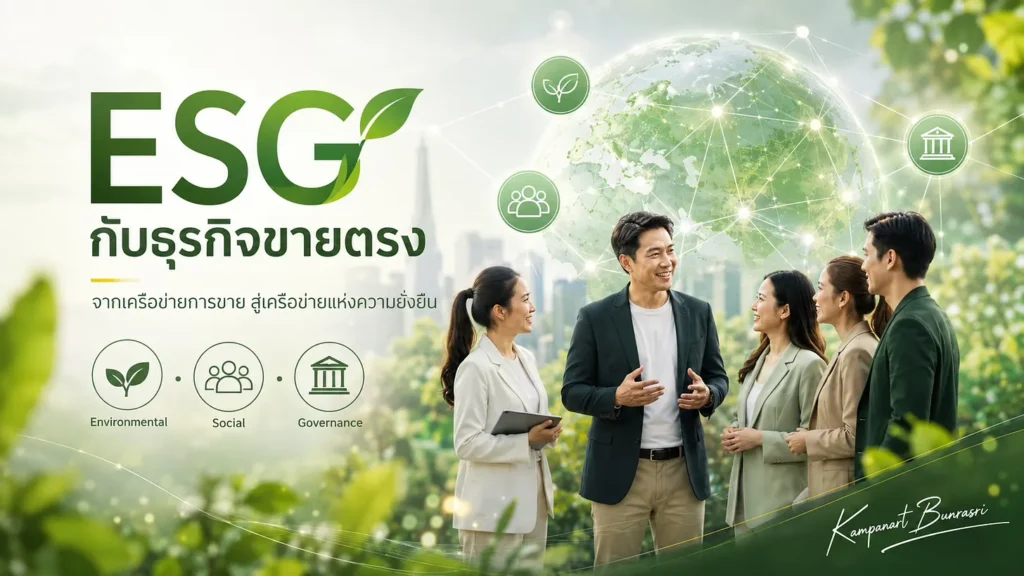
ESG is not a distant concept for direct selling businesses. It is an opportunity to strengthen trust, build resilient communities, and create growth that is more sustainable than short-term sales.
Direct selling businesses do not grow solely because of their products.
They do not grow solely because of compensation plans.
And they do not grow solely because of temporary promotions.
At its core, direct selling grows because of something much deeper:
Trust.
Trust between the company and its independent distributors.
Trust between distributors and consumers.
Trust between leaders and their teams.
And trust between the organization and society.
In a world where information travels faster than ever, consumers are more informed, businesses are under greater scrutiny, and younger generations increasingly support organizations based on their values rather than price or compensation alone, the key question for direct selling businesses is no longer:
“How much can we sell?”
Instead, it is:
“How can we continue to grow while maintaining integrity, transparency, and trust?”
One of the most important answers today is ESG.
What Is ESG and Why Should Direct Selling Businesses Care?
ESG stands for:
- Environmental
- Social
- Governance
In simple terms, ESG is a framework for conducting business responsibly across three critical dimensions.
E — Environmental
Responsibility toward the environment, including resource utilization, packaging, waste reduction, and minimizing environmental impact.
S — Social
Responsibility toward people, including employees, distributors, consumers, communities, equal opportunities, inclusion, and quality of life.
G — Governance
Responsible corporate governance, including transparency, ethics, legal compliance, accurate communication, and effective oversight mechanisms.
Globally, ESG principles are closely connected to human rights, labor standards, environmental responsibility, and anti-corruption initiatives, as reflected in frameworks such as the UN Global Compact. Sustainability disclosure standards, including IFRS S1, further encourage businesses to identify and disclose sustainability-related risks and opportunities that may affect long-term value creation.
ESG is not simply about “doing good.”
It is about managing risk, building trust, and designing a business that can thrive for the long term.
And when viewed through this lens, direct selling is one of the business models most closely connected to ESG because it is fundamentally people-centered.
How Direct Selling Connects to ESG
Unlike many traditional business models, direct selling involves multiple layers of relationships:
- Company to distributor
- Distributor to consumer
- Leader to team
- Organization to community
This makes ESG not an additional responsibility but something that already exists at the heart of direct selling.
When a company provides accurate product information, that is Governance.
When leaders support new distributors fairly, that is Social Responsibility.
When a company develops environmentally friendly packaging, that is Environmental Responsibility.
When training programs prevent exaggerated product or income claims, that is both Governance and Social Responsibility.
When a business creates legitimate income opportunities for ordinary people, that is Social Impact.
When a company maintains fair complaint-handling and product return systems, that is Governance that builds trust.
ESG should therefore not be viewed as a burden for direct selling businesses.
Instead, it should be viewed as the universal language that explains the values great direct selling organizations already strive to uphold.
The Challenge: Growth Without Trust
According to the World Federation of Direct Selling Associations (WFDSA), global direct selling retail sales reached approximately USD 163.9 billion in 2024, supported by more than 104 million independent distributors worldwide.
These figures demonstrate that direct selling is not a small industry.
It is a major economic ecosystem that affects millions of lives.
With scale comes responsibility.
When direct selling is conducted ethically, it creates opportunities, income, communities, and education.
However, when governance and accountability are weak, challenges emerge:
- Exaggerated income claims
- Misleading product claims
- Excessive focus on recruitment over genuine consumer sales
- Unequal treatment of new members
- Weak complaint resolution systems
- Lack of transparency and oversight
These are not merely reputation issues.
They are ESG issues—particularly within the Social and Governance dimensions.
ESG serves as a safeguard that prevents growth from becoming risk.
Environmental: From Products to Planetary Responsibility
Many people associate environmental responsibility only with factories, energy production, or heavy industry.
In reality, direct selling businesses also have meaningful environmental impacts through:
- Product packaging
- Logistics and transportation
- Inventory management
- Printed materials
- Events and conferences
- Consumer behavior
Environmental opportunities include:
- Reducing plastic packaging
- Increasing recyclable materials
- Digitizing business processes
- Improving logistics efficiency
- Reducing inventory waste
- Promoting sustainable and health-conscious products
Environmental responsibility is not about symbolic actions.
It is about asking:
“From product development to delivery, how can we reduce our impact on the world?”
Companies that embrace this mindset transform sustainability from a cost into a competitive advantage.
Social: The Greatest Strength of Direct Selling
Among the three ESG pillars, Social may be where direct selling has the greatest potential.
Direct selling is fundamentally a people business.
It provides opportunities for individuals to develop:
- Communication skills
- Leadership skills
- Sales capabilities
- Discipline
- Customer service expertise
- Entrepreneurial thinking
Many people discover their potential through direct selling.
Individuals who once lacked confidence learn to speak publicly.
People with no business experience learn how to lead teams.
Others find purpose, community, and personal growth.
This is real social impact.
However, opportunity must always be accompanied by responsibility.
Organizations must:
- Avoid creating unrealistic expectations
- Avoid exploiting people’s aspirations
- Support newcomers fairly
- Create inclusive opportunities
- Foster realistic and sustainable growth
Social responsibility is not measured by the number of people in a network.
It is measured by how well those people are supported, educated, and empowered.
Governance: The Backbone of Trust
If Social is the heart of direct selling, Governance is its backbone.
Good governance extends far beyond the boardroom.
It influences every presentation, every online post, every product claim, and every business opportunity shared with consumers and distributors.
Strong governance requires:
- Transparent and understandable compensation plans
- Responsible income disclosures
- Accurate product communication
- Ethics-focused training programs
- Fair complaint resolution systems
- Effective monitoring of online communications
- Leaders who model ethical behavior
Without governance, information can easily become distorted.
Health-support products may be misrepresented as disease treatments.
Business opportunities may be portrayed as guaranteed wealth.
Recruitment efforts may overshadow genuine customer value.
Governance protects trust by ensuring that growth remains grounded in truth and accountability.
ESG Transforms Direct Selling from Selling Products to Creating Value
Perhaps the most powerful aspect of ESG is that it aligns naturally with the direct selling model.
When approached superficially, ESG becomes an annual CSR activity.
When embraced strategically, ESG becomes the foundation of the business.
Environmental responsibility encourages sustainable products and operations.
Social responsibility creates fair opportunities and stronger communities.
Governance ensures transparency, ethics, and accountability.
Together, these pillars transform direct selling from a distribution channel into a sustainability network.
A network that:
- Delivers quality products
- Develops life and business skills
- Promotes healthier lifestyles
- Creates legitimate income opportunities
- Elevates industry standards
This is where ESG evolves from an obligation into a strategic opportunity.
Conclusion: ESG Is the Future of Sustainable Direct Selling
ESG is not reserved for large corporations.
Nor is it distant from direct selling.
In fact, direct selling may be one of the most powerful business models for bringing ESG principles to life.
Because direct selling is built on:
- Networks
- People
- Communities
- Learning
- Shared experiences
- Human relationships
When these strengths are guided by ESG principles, direct selling becomes more than a channel for distributing products.
It becomes a system that develops people, improves health, creates opportunities, builds trust, and generates positive social impact.
ESG is not a burden.
It is a compass.
A compass that continually asks:
- Are we growing responsibly?
- Are we treating people fairly?
- Are we protecting consumers?
- Are we creating opportunities or simply creating expectations?
- Are we selling products or creating value?
The direct selling companies that understand ESG today will be better positioned for the future—not because they appear more modern, but because they possess something deeper than short-term promotions, stronger than temporary sales growth, and more enduring than short-lived success:
Trust.
And in direct selling, trust is not merely an organizational asset.
It is the foundation of the future.